Animated version (Using Midjourney) of Isaac Asimov’s famous short story. Broken up into 6 chapters, each with a different visual style, the video is the complete short story which covers the entirety of time and space. Short story is known for the vastness covered in such a short narrative. How may entropy be reversed? How long would it take Multivac take to arrive at a answer for this last question?
Short story is broken up into 5 different chapters, each with a distinct visual motif: Chapter 1 – Adell and Lupov (Anime, ukiyo-e style)
Chapter 3 – VJ and Galactic AC (Film noir) (Music: Gerudo Valley – Malcura)
Chapter 4 – Zee Prime (Ancient Mediterranean) (Music: The Best is yet to come – Metal Gear solid)
Chapter 5 – The End of time – (Signalis / Ethereal style) (Music: Die Toteninsel – Signalis)
I had a ton of fun making this video. I did get the interesting mention in the comments on Youtube regarding that i was using AI generating imagery to animate a video about a super computer gaining sentience, adding a meta level to the video. Thought that was really interesting.
If for some reason you’d like to take the story in via vertical format, you can see all of the shorts from the video that have been published so far:
AI generated art is one of the latest areas of the coming wave of the artificial intelligence revolution. Artist have staged protests regarding models like Lensa, OpenAI’s GPT3 and the Diffusion AI generation models, since they were trained on artist’s image and can generated images in the style of an artist, with no attribution or compensation. Video inspired in part by the Artstation artist AI protest
I believe the artist staging the AI is theft protest are correct, their work was used in training machine learning models. These models would crawl the internet, and scrape images along with the alt text as a training data set, and thus can recreate images in very specific styles.
AI generated art is the current area of discussion in terms of the continuing automation of the economy and industry? What happens to the people and workers that get displaced? What happens to the wealth that will be generated by more efficient businesses and industry? Who is best positioned to take advantaged in the marketplace of these new, and efficient tools and technologies.
Currently AI tools are limited by many factors, among them computational and processing resources, but these limitations will be over come with time. What happens when natural language processing bots can convincingly generate misinformation articles? What happens when spam bot getting better and more clever? In time, image and video processing will be get better, what will be the impact of easy to generate deep fake videos generated by discriminatory and generative neural networks?
My concerns is not just AI, but who will be in control in these high tech business tools. The coming of AI and machine learning will not change the structure of our capitalist society, where wealth has been shifting up to the wealthy more and more with the passing of the decades. I fear AI and machine learning will be used to accelerate the process of wealth accumulation by the wealthy and “elites”.
Images were sourced from reddit.com/r/aiArt, generated with OpenAIs GPT3 or using Tensorflow’s Fast Style transfer algorithm
I’ve always been fascinated with the concepts of Artificial Intelligence, and automation. Especially since my entire adult life I’ve worked as an Engineer in factories and manufacturing settings. As machine learning technologies develop and progress, we are going to be seeing more and more applications for AI powered automation into more creative fields, such as content generation and image/art generation. So I thought it would be fun to see how much of a Youtube video on a given subject could be automated, or facilitated with machine learning, artificial intelligence and Python.
OpenAI offers cheap access to their Davinci language model and their GPT3 image generation model (https://beta.openai.com/docs/introduction) via their API. I wanted to pick a topic I am not an expert at, and since the day I was working on this was the day of the FIFA world cup, I thought that’d be a great choice for a test topic.
I used the DaVinci language model to facilitate the production of a script. Since the responses are limited, and the tool is not meant for long broad answers, I asked the DaVinci model a series of questions: “What is the World Cup” , “What is FIFA”, “When is the World Cup”, “How is the World Cup organized”, “Where is the World Cup”, “What the winners of the World Cup receive” and so forth. Once I removed the prompts I had asked it, I had a bout 700 words for a quick video essay of a few minutes.
Having a script, I ran it through a NLTK Natural language processing (NLP) which took the script, broke it down into sentences and placed them in a Python list, that I could iterate a loop over.
(Note, there is a small cost associated with these AI services, see OpenAI’s website for info, but it’s pretty cheap).
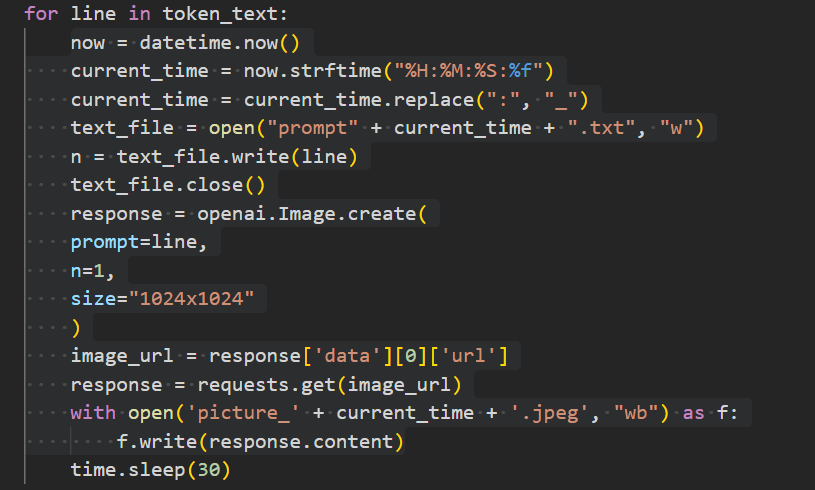
Using OpenAI’s API, I set up a for loop for each line in my Python list of sentences from the script that the DaVince Language model produced. The loop would feed the OpenAI image generation model one sentence at a time, and save the image that is generated. In the end, I would end up with about 30 images for my video, one for each sentence in the list generated from the script. Each image at 1024×1024 for the OpenAI image generating neural network cost about 1.5 cents (or $0.015) so 30 images at the largest resolution cost me less than a USD.
So now I had a script mostly generated by DaVinci (Did do some clean up and streamlining to make sure it flowed) and a series of images for my video essay on the FIFA world cup.
Next I used Google’s Text To Speech (TTS) service to generate a voice over with the script, and now I had about a 3 min audio file based on the script.
Loading up Premiere Pro, I cleaned up the audio since there were inconsistent pauses at paragraphs, set the narration to my generated images. The images mostly lined up with the prompt that was used to generate it in the video. Exported, and voila! I had a 3 min and change video that was mostly generated by algorithms or Artificial learning.
In conclusion, using AI and machine learning are very powerful tools to streamline the creation of content, correcting errors and speeding up portions of the workflow, saving people tons of time. Having said that, human review and touch is still needed, otherwise the content will lack that je ne sais quoi and authenticity that most people like from their small content creators. The images were hit or miss, but always interesting in trying to see how the model got trained, and what I generates based on the input.
I think most creators will have to face the options of eventually using some of these tools and techniques, or face being left behind with time. But the human element will always be needed so that the content is not sterile and lifeless.
Humanity, being the only species that we know of to achieve industrial technological society, has always looked around for peers or other intelligences to share this universe with. Every culture has looked up at the sky and wondered what’s out there. Life is better with friends anyway. While there are many forms of Intelligence on Earth, only one has achieved technological advancement to the point of mapping out the laws the universe and physics.
And yet – the Stars are quiet. Fermi’s paradox tells us that although we thought the universe would be crowded and full of noise, It’s a quiet and lonely home for humanity. Could the infinite Universe really be empty? Are we the only Witness to the expansion of Space-time, Of the fusion of the Stars, the quiet hum of cosmic background radiation? Are there any other Intelligences out there wondering why the universe is expanding? Witnessing this Cosmic opera play out? Is the universe like a dark forest or a Barren Wasteland ?
If a civilization falls in the cosmic forest and nobody is around to hear it, does it make a noise?
Drake’s equation suggests that mathematically we should have many companion species out in the stars, Other species or intelligences to have industrialized and achieve technical wonders.The infinite monkey theorem tells us that given enough instances any outcome is possible. There are trillions of stars and trillions upon trillions of planets. Do any of these planets also hold listeners?
Are there any other species that live in populated Industrialized technological worlds that spit out tons of electromagnetic noise, radio frequency, Infrared, Microwave ultraviolet Lighting up their section of the Galaxy?
In its loneliness, humanity now seeks to create a friend, an ally, a companion, A mechanical mind, a positronic brain – To work alongside us to unravel the secrets of engineering and science. Where we couldn’t find intelligences out in the stars humanity rather seeks to create it out of machines. Someone who will help out with all the work that it takes to be alive, and this Enterprise called civilization
The idea of robotic artificial companions has long captured The imagination of humanity and its thinkers. Descriptions of artificial intelligence and mechanized people are as old as so many of our technologies and sciences, as old as our cities and universities.
But what type of companions would these artificial minds be? How would they work with us? Will they lead us to a golden era, complimenting our weaknesses, enhancing our strengths, building a greater better society. Or would our relationship take a darker turn of competitive rivalry. If we are to build our companions, how will we make sure that they don’t turn against us? How can we be sure that sharing civilization with them isn’t a mistake? Could we make ourselves better friends and companions better than we could ever find out in the Stars?
If we’ve built the positronic brain, what will the day of technological singularity be? The moment when the artificial brain can outcompete the human in every way, without weaknesses or limitations. Would the robots be kinder to humanity than we were to ourselves or would it repeat the same mistakes that we have in the past? Choosing to rule through violence and submission? A new form of imperialism, Al robotic imperialism. Would the robots also seek to dominate?
Issac Asimov proposes 3 laws upon which all architecture of the artificial mind should be built. Guiding principles for building all mechanical thinking machines, positronic brains. The 3 laws of robotics. Lower law being subservient to the higher laws
First Law
A robot may not injure a human being or, through inaction, allow a human being to come to harm.
Second Law
A robot must obey the orders given it by human beings except where such orders would conflict with the First Law.
Third Law
A robot must protect its own existence as long as such protection does not conflict with the First or Second Law.
So if robots wanted to continue to follow the first law, to better protect humanity; an addendum would be needed. The way for them to hurt a person – bending the laws, but achieving the objective to protect Humanity As a whole on a grander scale
An additional law would be needed, One that can supersede the first three laws. That would allow the robots to make the hard choices for the best of humanity. To hurt an individual but help the herd. A robotic law that allows the robots to function as a quiet, silent, Hidden Hand That guides the course of human civilization from the shadows shaping the outcome of human events.
Zeroth Law
A robot may not harm humanity, or, by inaction, allow humanity to come to harm.
 Taco Banana