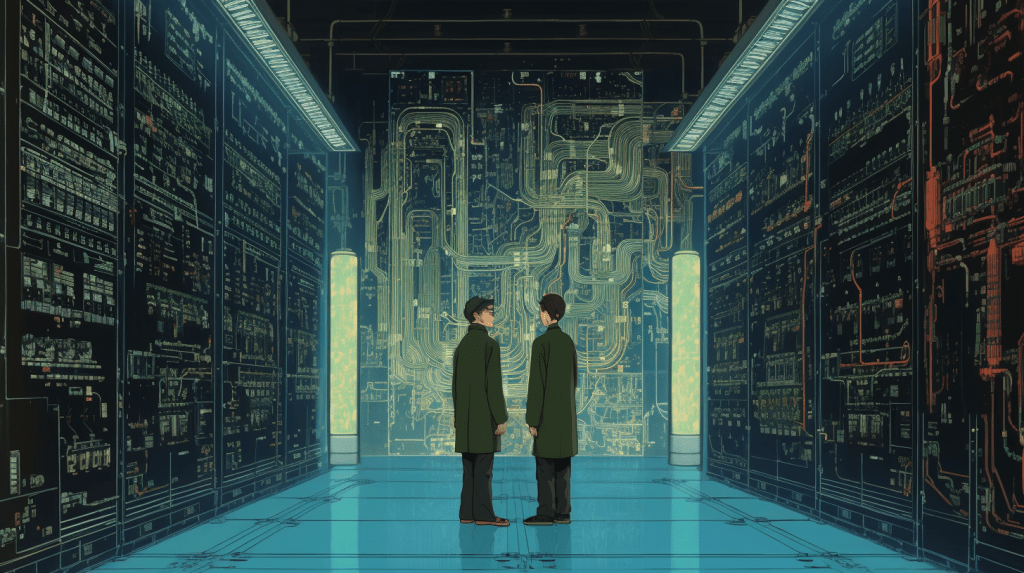
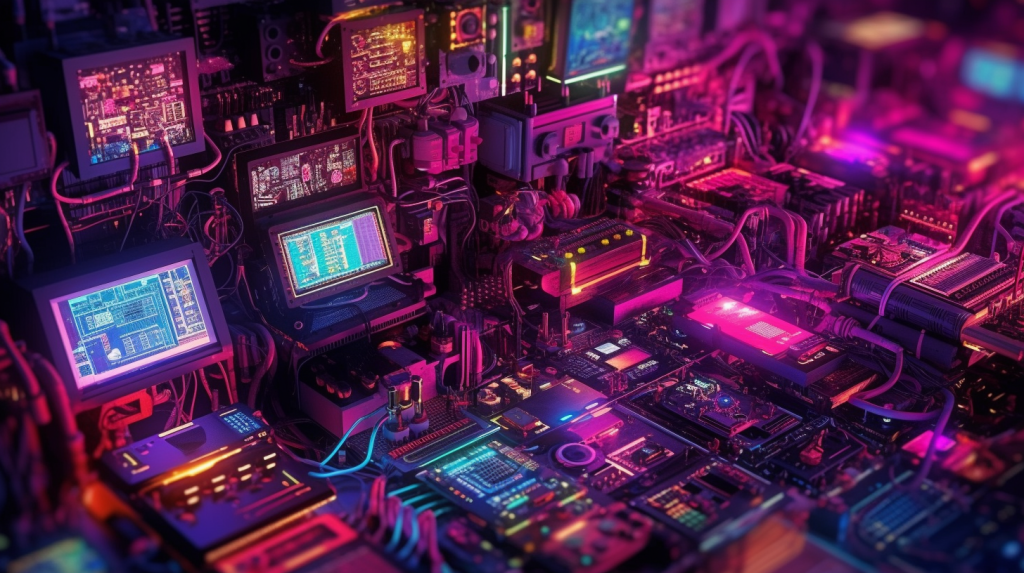
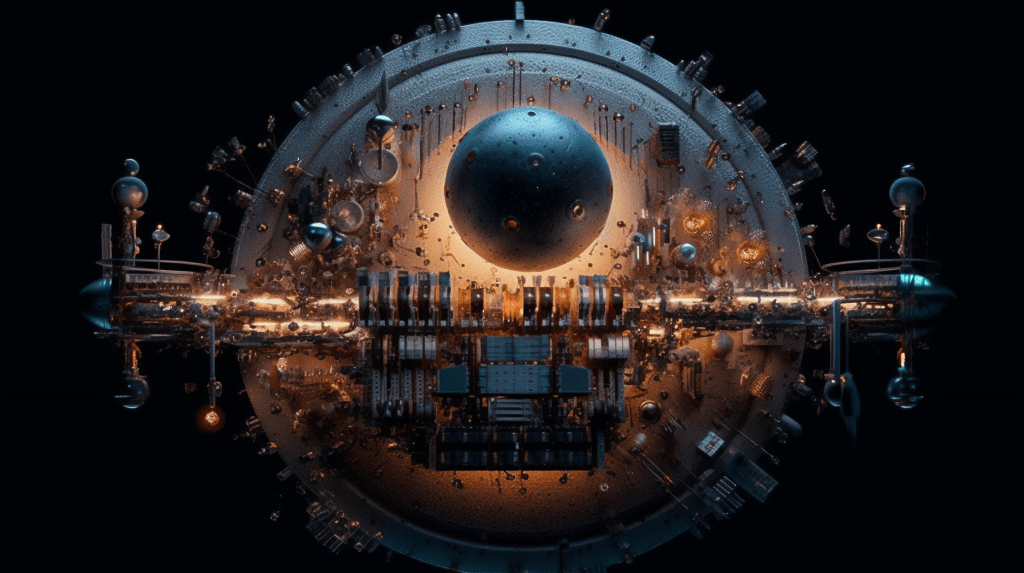
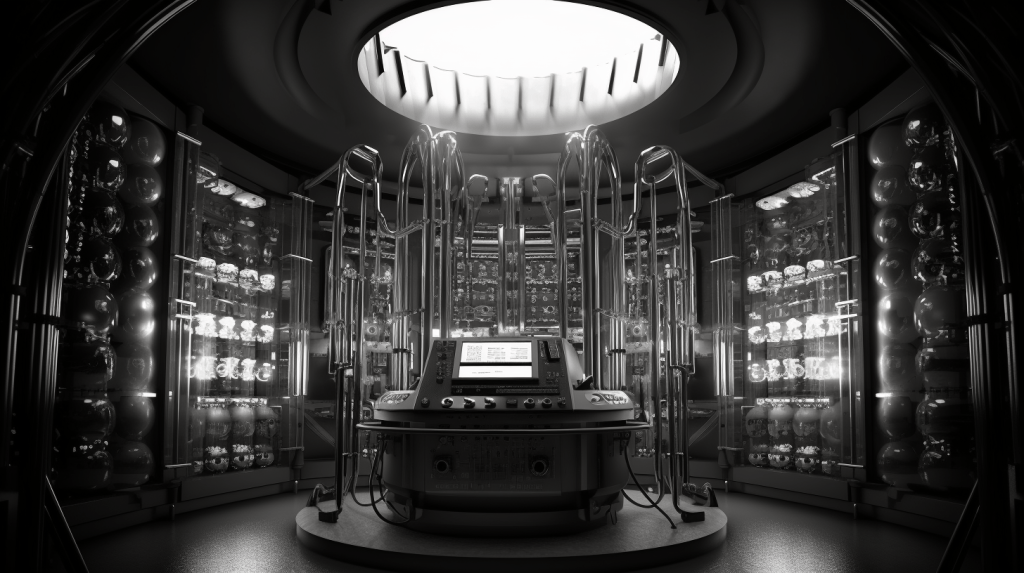
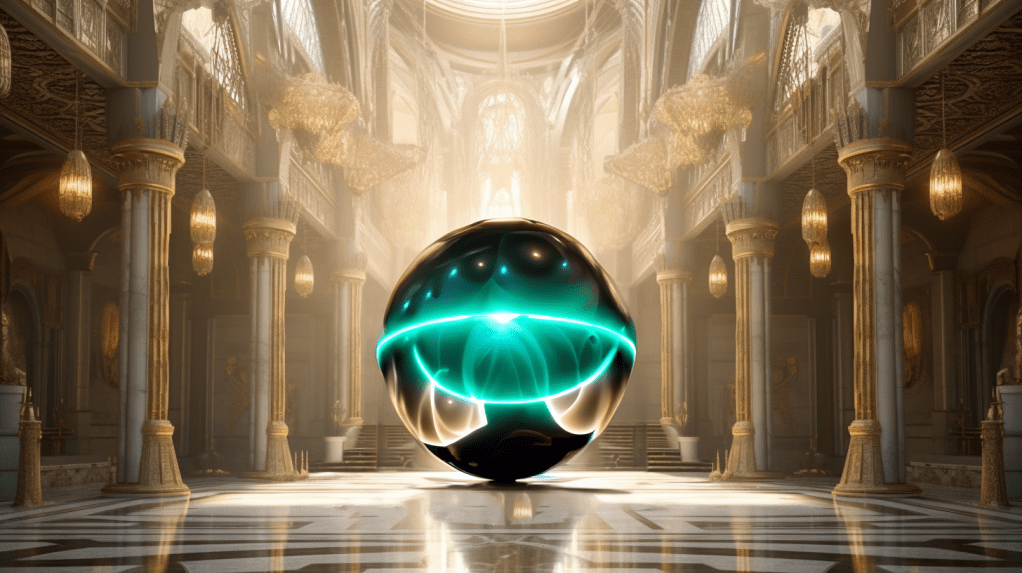
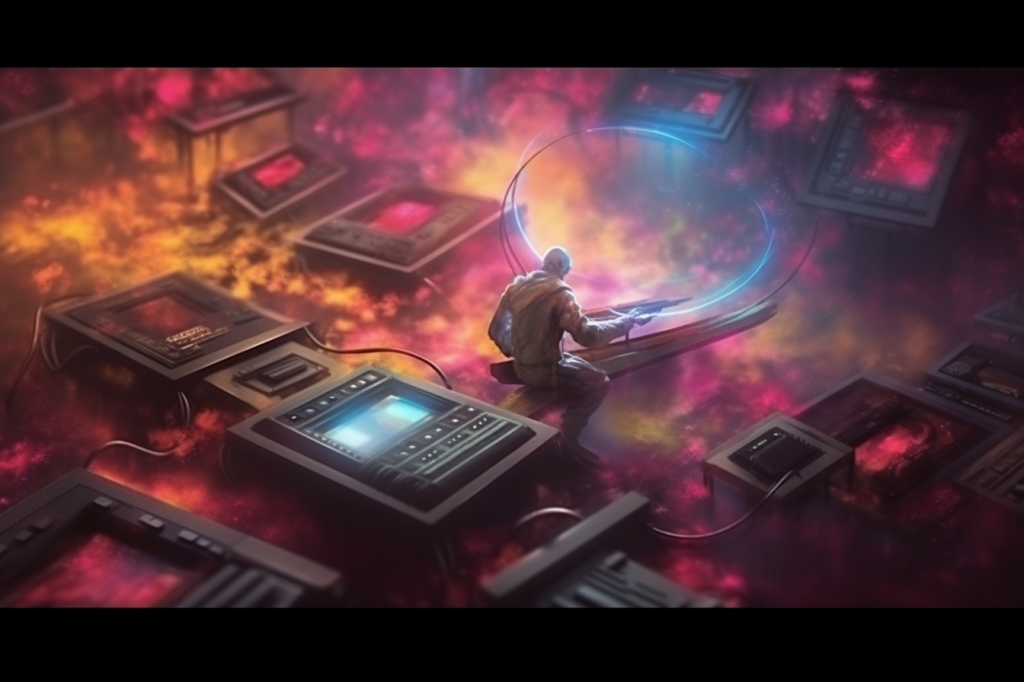
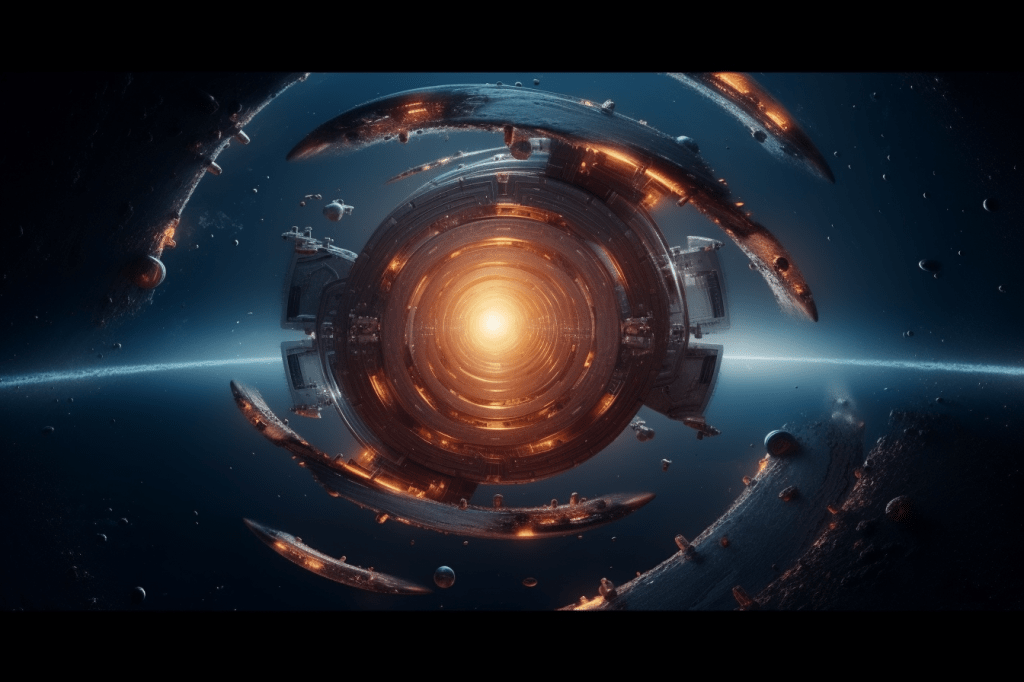
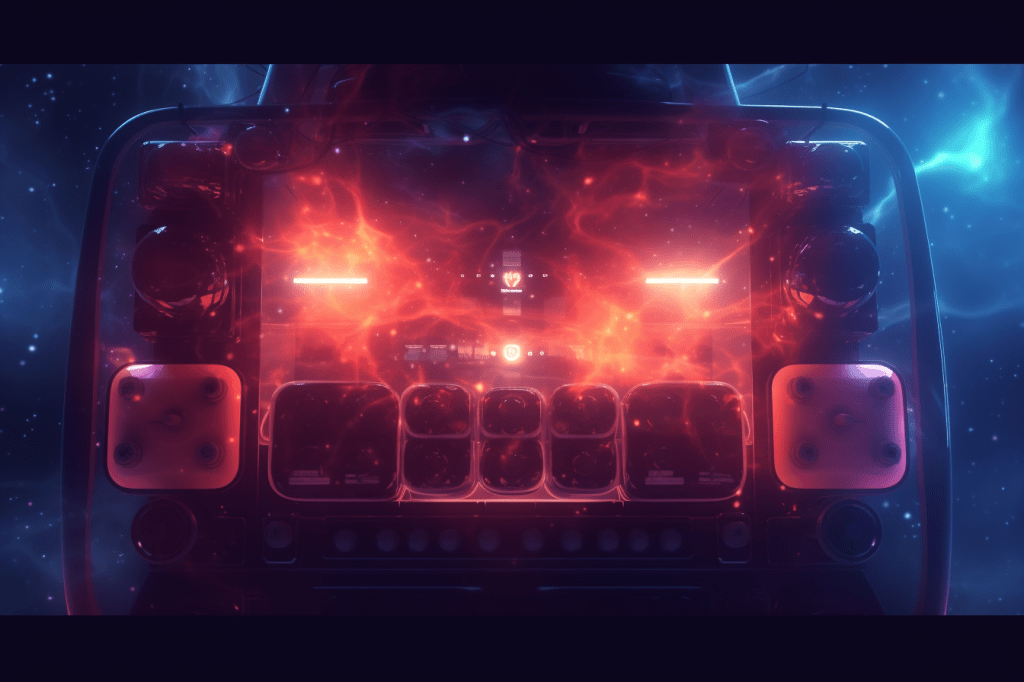
In Asimov’s short story “The Last Question” we get to see the evolution of the supercomputer, Multivac, from a “humble” super computer, to becoming a universal ethereal super computer that resides in hyperspace. The short story was animated using Midjourney and Premiere Pro, and it was a interesting and fun challenge to try to animate or visualize this evolution of a computer. Going from a cavernous super computer resembling a modern data center, to a ghostly entity that lives in hyperspace. Here is my visualization of this evolution:
Animated version (Using Midjourney) of Isaac Asimov’s famous short story. Broken up into 6 chapters, each with a different visual style, the video is the complete short story which covers the entirety of time and space. Short story is known for the vastness covered in such a short narrative. How may entropy be reversed? How long would it take Multivac take to arrive at a answer for this last question?
Short story is broken up into 5 different chapters, each with a distinct visual motif: Chapter 1 – Adell and Lupov (Anime, ukiyo-e style)
Chapter 3 – VJ and Galactic AC (Film noir) (Music: Gerudo Valley – Malcura)
Chapter 4 – Zee Prime (Ancient Mediterranean) (Music: The Best is yet to come – Metal Gear solid)
Chapter 5 – The End of time – (Signalis / Ethereal style) (Music: Die Toteninsel – Signalis)
I had a ton of fun making this video. I did get the interesting mention in the comments on Youtube regarding that i was using AI generating imagery to animate a video about a super computer gaining sentience, adding a meta level to the video. Thought that was really interesting.
If for some reason you’d like to take the story in via vertical format, you can see all of the shorts from the video that have been published so far:
Entropy is one of what I consider a mystery of the universe (along with Dark Matter and Dark Energy). Entropy itself is not a mystery, but rather why does it only ever increase? And why was the Big Bang a moment of tremendously low entropy? How did entropy reverse itself? Entropy reversing is the central theme to Isaac Asimov’s short story “The Last Question” (You can read it here: https://www.physics.princeton.edu/ph115/LQ.pdf)
In the short story, humanity rises, falls and transcend all without being able to figure out how did entropy reverse itself, even with the help of the super computer Multivac. Multivac started off as a super computer, but as the story continues, it becomes a transcendent universe computational entity, that once humanity has faded, is able to figure out, Why did entropy reverse itself at the beginning of time.
Entropy is defined as: “Entropy is a thermodynamic quantity that measures the amount of disorder or randomness in a system. It is a measure of the energy dispersal in a system. Low entropy means that the system is ordered, while high entropy means the system is disordered.”
In short, you can think of it as a measure of how “spread out” energy is in the universe. At the beginning of time, it was concentrated, at the end of time, energy will be evenly spread out across the universe.
Humanity, being the only species that we know of to achieve industrial technological society, has always looked around for peers or other intelligences to share this universe with. Every culture has looked up at the sky and wondered what’s out there. Life is better with friends anyway. While there are many forms of Intelligence on Earth, only one has achieved technological advancement to the point of mapping out the laws the universe and physics.
And yet – the Stars are quiet. Fermi’s paradox tells us that although we thought the universe would be crowded and full of noise, It’s a quiet and lonely home for humanity. Could the infinite Universe really be empty? Are we the only Witness to the expansion of Space-time, Of the fusion of the Stars, the quiet hum of cosmic background radiation? Are there any other Intelligences out there wondering why the universe is expanding? Witnessing this Cosmic opera play out? Is the universe like a dark forest or a Barren Wasteland ?
If a civilization falls in the cosmic forest and nobody is around to hear it, does it make a noise?
Drake’s equation suggests that mathematically we should have many companion species out in the stars, Other species or intelligences to have industrialized and achieve technical wonders.The infinite monkey theorem tells us that given enough instances any outcome is possible. There are trillions of stars and trillions upon trillions of planets. Do any of these planets also hold listeners?
Are there any other species that live in populated Industrialized technological worlds that spit out tons of electromagnetic noise, radio frequency, Infrared, Microwave ultraviolet Lighting up their section of the Galaxy?
In its loneliness, humanity now seeks to create a friend, an ally, a companion, A mechanical mind, a positronic brain – To work alongside us to unravel the secrets of engineering and science. Where we couldn’t find intelligences out in the stars humanity rather seeks to create it out of machines. Someone who will help out with all the work that it takes to be alive, and this Enterprise called civilization
The idea of robotic artificial companions has long captured The imagination of humanity and its thinkers. Descriptions of artificial intelligence and mechanized people are as old as so many of our technologies and sciences, as old as our cities and universities.
But what type of companions would these artificial minds be? How would they work with us? Will they lead us to a golden era, complimenting our weaknesses, enhancing our strengths, building a greater better society. Or would our relationship take a darker turn of competitive rivalry. If we are to build our companions, how will we make sure that they don’t turn against us? How can we be sure that sharing civilization with them isn’t a mistake? Could we make ourselves better friends and companions better than we could ever find out in the Stars?
If we’ve built the positronic brain, what will the day of technological singularity be? The moment when the artificial brain can outcompete the human in every way, without weaknesses or limitations. Would the robots be kinder to humanity than we were to ourselves or would it repeat the same mistakes that we have in the past? Choosing to rule through violence and submission? A new form of imperialism, Al robotic imperialism. Would the robots also seek to dominate?
Issac Asimov proposes 3 laws upon which all architecture of the artificial mind should be built. Guiding principles for building all mechanical thinking machines, positronic brains. The 3 laws of robotics. Lower law being subservient to the higher laws
First Law
A robot may not injure a human being or, through inaction, allow a human being to come to harm.
Second Law
A robot must obey the orders given it by human beings except where such orders would conflict with the First Law.
Third Law
A robot must protect its own existence as long as such protection does not conflict with the First or Second Law.
So if robots wanted to continue to follow the first law, to better protect humanity; an addendum would be needed. The way for them to hurt a person – bending the laws, but achieving the objective to protect Humanity As a whole on a grander scale
An additional law would be needed, One that can supersede the first three laws. That would allow the robots to make the hard choices for the best of humanity. To hurt an individual but help the herd. A robotic law that allows the robots to function as a quiet, silent, Hidden Hand That guides the course of human civilization from the shadows shaping the outcome of human events.
Zeroth Law
A robot may not harm humanity, or, by inaction, allow humanity to come to harm.






 Taco Banana